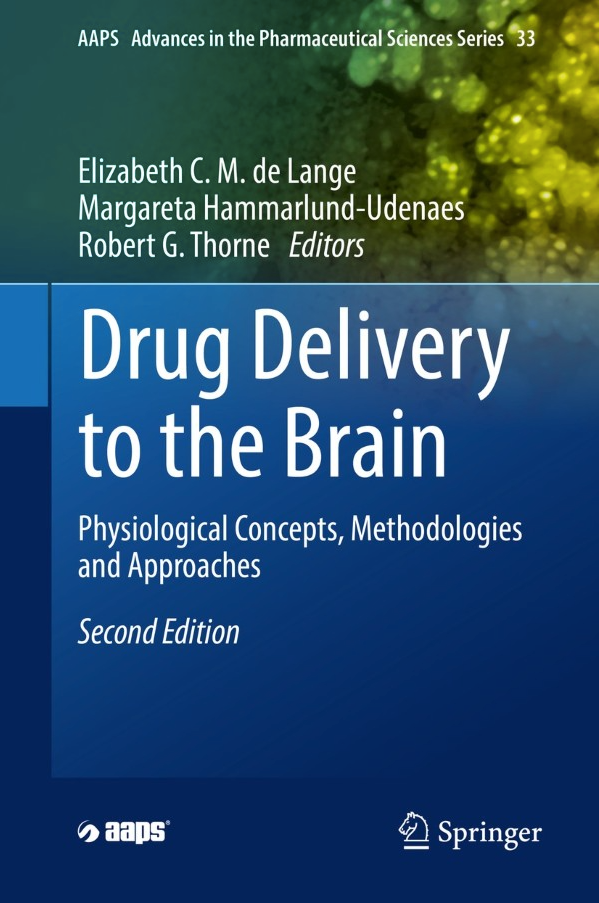
Program
12th Course on the BBB in CNS Drug Development
Principles, Transport Kinetics, Methods & Translation to humans
Course dates to be determined in due time
The Program
DAY I
Basic Aspects of the Blood-Brain Barrier and Pharmacokinetic Principles
| 09.00 – 09.30 |
Welcome a: Wednesday Oct 5thnd Introduction |
| 09.30 – 10.00 |
BBB Morphology, Anatomy, Physiology and Function |
| 10.00 – 10.30 |
Coffee and tea |
| 10.30 – 11.30 |
Mechanism of BBB transport intrabrain distribution including integrated exercise |
| 11.30 – 12.30 |
BBB transport and intrabrain distribution: Rate and extent. Impact on brain vs plasma PK, including PK principles, including integrated exercise |
| 12.30 – 13.30 |
Lunch |
| 13.30 – 13.50 |
In vitro methods (cell cultures, monolayers) |
| 13.50 – 14.10 |
In situ methods (brain sampling techniques) |
| 14.10 – 14.30 |
In vivo monitoring methods: CSF & microdialysis |
| 14.30 – 14.45 |
In vivo monitoring methods: PET (time, space, not unbound, terminology vs PK), CT, MRI, gadolinium etc. |
| 14.45 – 15.30 |
Coffee and tea |
| 15.30 – 16.30 |
Combinatory Mapping Approach to determine distribution of drugs between different brain sites, including integrated exercise |
| 16.30 – 17.00 |
Exercise on BBB and intra-brain factors on obtained target site concentrations |
| 17.00 – 17.30 |
Summing up and discussion of Day I |
| 18:00 |
Dinner at the course hotel |
DAY II
Approaches to improve CNS target site delivery
| 09.00 – 09.15 |
Use of active transporters for efflux and influx |
| 09.15 – 09.30 |
Invasive methods (mannitol infusion, injections,…) |
| 09.30 – 09.40 |
Focused ultra-sound |
| 09.40 – 10.10 |
Nanocarriers as a field with promise |
| 10.10 – 10.40 |
Coffee and tea |
| 10.40 – 11.40 |
Use of receptor-mediated transport for large molecules |
| 11.40 – 12.40 |
Hands-on exercise: impact of variability in rate and/or extent of transport on target site concentrations |
| 12.40 – 13.40 |
Lunch |
| 13.40 – 14.00 |
In silico methods |
| 14.00 – 14.30 |
CNS PBPK model approaches- (ULEICNSPK3.0) |
| 14.30 -15.00 |
Applications on CNS PBPK |
| 15.00 – 15.30 |
Coffee and tea |
| 15.30 – 16.00 |
Sources of variability in CNS drug distribution |
| 16.00 – 17.00 |
Hands-on exercise Shiny App Part 1 – for animals |
| 17.00 – 17.30 |
Summing up and discussion of Day II |
| 18.00 |
Dinner downtown |
DAY III
Integration and translation (to human) of CNS drug delivery principles
| 09.00 – 10.00 |
Translational PK and PKPD relationships of CNS active drugs |
| 10.00 – 10.30 |
Coffee and tea |
| 10.30 – 11.00 |
Transporters and their translation between species |
| 11.00 – 12.00 |
Hands-on exercise Shiny App Part 2 – for humans |
| 12.00 – 13.00 |
Lunch |
| 13.00 – 14.00 |
Overall perspectives |
| 14.00 – 15.00 |
Discussions in break-out rooms on learning experience – what has been important learning experiences for you? |
| 15.00 |
End of course |
For participants based in Sweden, please add VAT 25 %. Participants outside of Sweden do not need to pay VAT.
*PhD students should accompany this form by a letter of their supervisor to ensure the status of PhD student.
Evaluations from the previous BBB course in Uppsala
- I found the course to be very valuable for my present work: Average 9.1 on a 1 – 10 scale, where 10 is “very much”.
- I would very much like to recommend this course to colleagues: Average 9.5 on a scale 1 – 10, where 10 is “very much”.